On-site containment
May reduce haulage and landfill use if sufficient suitable ground is available. Allow for cell excavation, membrane design and sealing where required, backfill, records, monitoring and restrictions on future disturbance.
Commercial land • Development sites • Estates
Could retaining eligible invasive plant material on your site be a better option than exporting it? Start with the species, the ground conditions and the regulatory constraints—not a promise of burial.
Request an on-site assessment through our existing enquiry form. Scope, suitability, fees and dates are confirmed directly; submitting a request does not book works.
A burial cell retains eligible plant material and affected soil in a mapped, designated area at the site of origin. On-site encapsulation uses a suitable, securely sealed geotextile membrane to isolate the material where the applicable rules allow it. It is containment—not proof that propagules have been destroyed, a licence to move waste between sites, or a guarantee that land can later be excavated freely.
We take enquiries for feasibility assessment and a managed service where site conditions permit. Availability and the appropriate specialist arrangement are confirmed after review. This page does not claim completed burial-cell projects, existing authorisations or guaranteed approval.
May reduce haulage and landfill use if sufficient suitable ground is available. Allow for cell excavation, membrane design and sealing where required, backfill, records, monitoring and restrictions on future disturbance.
Can remove affected material from the site where retention is unsuitable. It needs secure handling, an appropriately registered carrier where required, a receiving facility permitted to accept the waste and relevant transfer records.
Control and follow-up without bulk excavation may be more proportionate where programme and land use allow. For balsam, stopping seed production and repeated checks often matter more than constructing a cell.
No fixed prices, percentage savings or insurance-backed burial guarantees are offered. Explore waste disposal or management planning.
Check the current Environment Agency RPS 178 for England and Natural Resources Wales RS 058.3 for Wales before designing or starting work. Neither statement is a permit or site approval, and neither removes other legal duties. Do not extend these positions automatically to Scotland, Northern Ireland or Ireland.
The knotweed burial section covers Japanese knotweed. For other plants, the burial route is limited to eligible invasive non-native species from aquatic, riparian and wetland habitats with a biosecurity risk requiring on-site disposal. The non-knotweed burial limit is 1,000 tonnes. Notify the Environment Agency at least one week before Japanese knotweed burial under the RPS.
Read the full RPS 178 conditionsNRW covers Japanese and other listed invasive non-native knotweeds. For non-knotweed burial, first rule out other options presenting no environmental risk, such as composting without regrowth or spread. NRW requires a biosecurity risk assessment, has 1,000-tonne limits for the burial routes, and requires at least one week’s notification before knotweed burial. Species licensing may also apply.
Read the full RS 058.3 conditionsSubject to the jurisdiction’s knotweed scope and every other condition.
Not an ordinary liner: membrane suitability and sealing are essential.
Eligibility differs. Crassula helmsii requires a membrane; NRW explicitly specifies 2m and sealing.
Suitable membranes must be undamaged, securely sealed, UV resistant, large enough to minimise joins and capable of remaining intact for at least 50 years. That is a material requirement in the guidance—not a guarantee offered by this business. Burial is at the site of origin only. Both positions require low-habitat-value ground, an area likely to remain undisturbed, more than 7 metres from an adjacent landowner’s site, protection of groundwater and compliance records kept for two years.
Assess planning requirements and landowner consent, protected habitats and species, flood risk, groundwater, services, excavation stability, contaminated ground, access and future development. These thresholds do not make bamboo, bindweed, horsetail, wetlands, proximity to water or restricted sites automatically eligible. If conditions cannot be met, obtain regulator advice on the necessary permissions or choose an appropriate alternative.
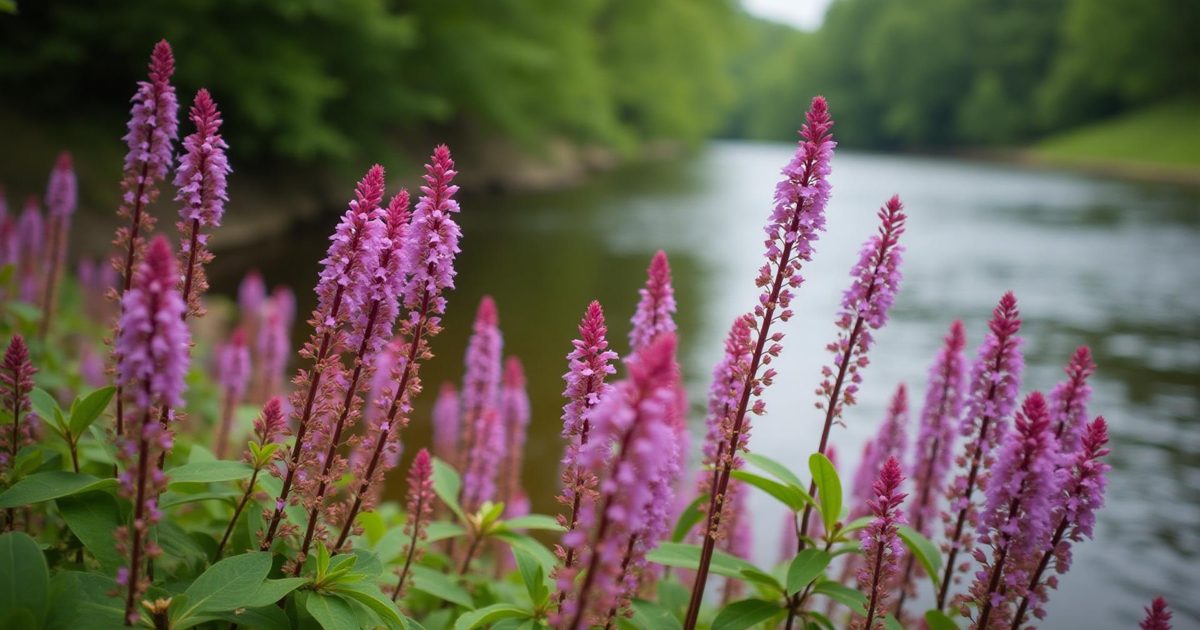
Himalayan balsam is an annual that spreads by seed, not a persistent knotweed rhizome network. Its explosive pods release seed that can travel along watercourses. Seeds can remain viable beyond the season in which they are shed; fresh upstream inputs can also reinfest a cleared bank. Follow-up in subsequent seasons is needed, and a single clearance or burial operation does not prove absence.
For stands without mature seed pods, carefully timed pulling or cutting before seed production, with safe handling and repeat checks, is often more proportionate than soil excavation. Uprooted stems can re-root in damp conditions. Do not disturb mature pods or assume seed-bearing soil is safe to compost or move.
Riparian stands need special care: excavation can destabilise banks, strip native cover and increase erosion after winter dieback. Floodwater can mobilise material, and groundwater or nearby water may make a proposed cell unsuitable. Habitat protection and environmental assessment take priority over retaining waste on site. Burial is a conditional option for qualifying material—not a recommendation for every balsam stand.
Read our Himalayan balsam treatment guide · RHS balsam guidance
01
Provide the site postcode, suspected species, photos, affected area, land ownership and project programme. Explain nearby water, access limits and whether soil has already been moved.
02
Review the regulatory route, ecology, ground and water risks, future disturbance and available space. Compare containment with in-situ management and permitted off-site disposal.
03
If suitable, confirm the proposed design, specialist responsibilities, required permissions and notifications, biosecurity, records, monitoring and future excavation restrictions before works are agreed.
No. Identification, jurisdiction, waste eligibility, habitat, groundwater, flood risk, site layout and future use must be assessed. These rules are not a universal solution for bamboo, bindweed or horsetail, or an automatic option for wetlands, land near water or restricted sites.
Under the relevant conditions, Japanese knotweed in England and invasive non-native knotweeds in Wales require at least 5 metres without a suitable sealed geotextile membrane, or at least 2 metres with one. The material must remain at its site of origin and every applicable condition must be met. Depth alone does not establish suitability or authorisation.
Sometimes eligible seed-bearing material or soil may need containment, but burial is not the default for a balsam stand. Pre-seed control and repeat monitoring often avoid excavation. Near rivers, bank stability, flooding, groundwater and native habitat can make burial unsuitable; a site-specific environmental assessment comes first.
No. England’s Environment Agency RPS 178 and Wales’s Natural Resources Wales RS 058.3 are different, conditional regulatory positions, not permits or project approvals. Check the current statement and all other required permissions, licences, planning and landowner requirements before work. They do not automatically apply in Scotland, Northern Ireland or Ireland.
It may reduce haulage and landfill use where retention is suitable, but excavation, membrane installation, engineering, records, monitoring and restrictions on future land use also have costs. Compare the complete site-specific options; there is no fixed price or guaranteed saving.
Tell us you are enquiring about burial-cell feasibility in the site details. We’ll confirm availability and the appropriate assessment scope; no works or authorisations are implied.
Request a Burial Cell Feasibility Survey